
Fast by Design: Why Slow Platforms Use Dangerous Speed Tricks to Fake It
Every slow platform ships with a medicine cabinet

You can spot a slow platform without benchmarking it. Open its plugin marketplace and search "speed." Page after page: cache managers, minifiers, image optimizers, lazy-loaders, database cleaners, critical-CSS generators. Each one has five-star reviews and a changelog full of "fixed conflict with [other speed plugin]."
Fast platforms don't need that shelf. The existence of the shelf is the confession.
The tricks, and exactly how they bite
The cache stack. Page cache. Object cache. Opcode cache. CDN cache. Browser cache. Each one is pitched as free speed, and each one adds a fresh answer to the only question that matters: which version of this page is the customer seeing right now? Cache invalidation is famously one of the two hard problems in computer science, so a platform that answers it five separate times has five chances to show a stale price, a dead checkout, or someone else's session. And the debugging experience is its own reward: clear the wrong cache and the bug "fixes itself," then comes back next Tuesday.
Minify and combine everything. Merge all your stylesheets into one file and all your scripts into another, then strip every whitespace byte. Works beautifully until two scripts that depended on load order swap places, or an inline snippet loses the library it needed. That's how contact forms and analytics die so quietly that nobody notices for two weeks. We have cleaned up after exactly this. The form was a form in name only.
Defer all the JavaScript. Move every script to the bottom of the page for a better speed score, and then the slider stops rendering, the payment button stops responding, and analytics quietly loses half its events. Deferral is a fine tool when used deliberately. As a blanket "optimization," it's a coin flip on every interaction your business depends on.
Lazy-load everything, including the thing people came for. Every image gets a loading hint, every embed gets deferred. The score goes up, and the hero image (the one asset the visitor actually waited for) now arrives last. You optimized the measurement and made the experience worse.
Critical-CSS generators. A robot guesses which styles your page needs above the fold, inlines them, and loads the real stylesheet later. When the guess is wrong (and on any page with real layout, it eventually is), you get flashes of unstyled content, shifting layouts, and a theme update that silently invalidates the guess.
"Clean up your database." A one-click plugin offers to delete revisions, transients, and "orphaned data." Sometimes the data wasn't as orphaned as advertised. There's a reason the undo button exists, and there's a reason this button doesn't have one.
Optimizing for the grader. The thread tying all of these together: most of these tools exist to move a number in a scoring tool, not to make the site better for an actual human on an actual phone. Speed theater.
Why the tricks are dangerous
Because every one of them trades correctness for speed on a system that was slow to begin with, and the failure mode is never "the site got slightly slower." It's a silently dead form. A checkout that breaks mid-order. A cached page showing last month's pricing. An optimizer plugin that "helpfully" edits a core file and takes the whole site down mid-launch. Nobody audits a speed plugin for correctness. They install it for a score.
The honest alternative: don't need the tricks
HypecastCMS was built on a simpler idea: if the platform is small, you don't have to hide its weight.
Server-rendered pages. Your pages ship as finished HTML. No client framework inflating itself on load, no render-blocking bootstrap, nothing that needs to be deferred, minified, or preloaded into submission.
Fingerprinted, immutable assets. Every stylesheet and script URL carries a content fingerprint. Change the file and the URL changes with it, so assets can be cached aggressively and never serve stale content. Caching is only dangerous when content can go stale. Ours can't.
No third-party plugin pile. The components on a HypecastCMS page come from the platform itself and pass a linter before they can publish. No surprise scripts, no conflicting optimizers, nothing installing itself onto your page from a marketplace.
A small HTML budget. No page-builder bloat, no dozen nested wrappers per section, no half a megabyte of CSS to render a hero and a button. The fastest code is the code that was never sent.
We didn't ask you to take our word for it
In October we ran an output audit: nine real customer pages built on popular site builders, fetched and measured side by side with two of our own live pages. No lab conditions, no cherry-picked demos. Just what each platform actually ships to a visitor.
Re-measured November 2, 2026:
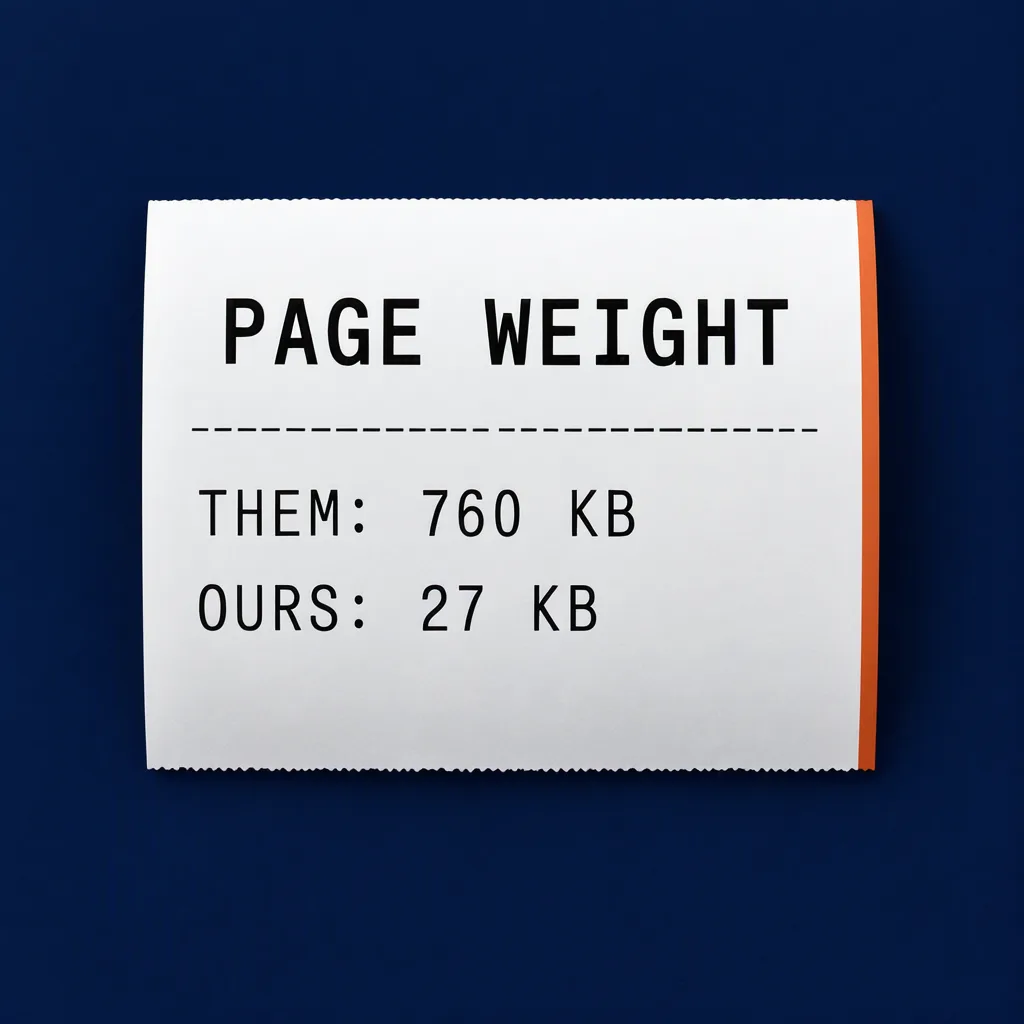
HTML payload. Our live pages: 18.8 KB and 26.9 KB. Builder-built samples: 49 KB to 760 KB.
Script tags. Ours: 1 and 3. Samples: 2 to 28.
Image alt text. Ours: 100% coverage. Samples: down to 0% on some pages.
Heading structure. Ours: clean, single h1 in order. Samples: missing h1s, one page mixing 39 h2s with 4 h1s.
The lightest competitor page we sampled still outweighed our heaviest page. The heaviest was a Wix customer site whose HTML alone weighed 760 KB. Before a single image loaded. Both of our full homepages together weigh less than that one document.
Weight was only half the audit. The other half was correctness. Every one of our pages carried alt text on every image and a clean heading order. Some samples shipped pages with no alt text at all, no h1 anywhere, or heading soup. And the one builder that kept its script count low made up for it by skipping alt text and structure entirely. A speed score can be gamed. The weight and the structure are what a visitor actually receives, on every single load.
That's September's argument with receipts attached, and it's the same story our No Duct Tape post tells from the platform side: less machinery, fewer moving parts, fewer things that can silently break.
One question for your current platform
Turn off every speed and optimization plugin. Now how fast is it?
If the honest answer is "unusable," then you don't have a fast site with optimizations. You have a slow site with an alibi.
HypecastCMS sites are fast by default: nothing to babysit, no cache to clear after every edit, nothing waiting to break at 2 a.m. That's not an optimization trick. It's just what happens when you build the platform small on purpose.
→ See what managed hosting on a fast-by-default platform looks like.